Video 1 of 3
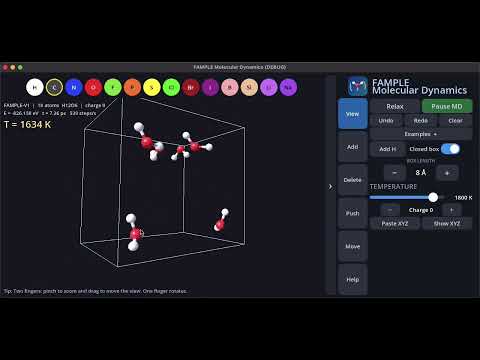
Water formation from H₂ + O₂
Hydrogen and oxygen molecules collide, their bonds break, and the atoms recombine into water. The simulation shows the rearrangement that the balanced equation hides.
2 H₂ + O₂ → 2 H₂O
Molecular dynamics app
FAMPLE Molecular Dynamics simulates molecules as atoms that move, collide, break bonds and form new ones. Instead of drawing a reaction as a static equation, you see the reactants approach, rearrange and turn into products.
The app
FAMPLE Molecular Dynamics is a molecular dynamics (MD) application for exploring chemical reactions. You build a starting set of molecules, set the conditions, and let the simulation run. At every time step the app computes the forces between atoms and moves them according to Newton's laws of motion.
Because bonds are allowed to break and form during the run, the simulation does more than show molecules vibrating. It can show a real reaction pathway: which atoms meet first, which bonds give way, and how the product molecule ends up assembled. That makes FAMPLE a useful tool for teaching and for building intuition about reaction mechanisms.
How it works
Place the reactant molecules in the simulation box with their atoms, bonds and starting positions.
At each time step the app evaluates the forces every atom feels from its neighbours.
Positions and velocities are advanced in tiny femtosecond-scale steps, producing a trajectory.
Bonds break and form as atoms collide, and the trajectory is rendered as an animation you can follow.
Videos
Three reactions, each run as a molecular dynamics simulation.
Video 1 of 3
Hydrogen and oxygen molecules collide, their bonds break, and the atoms recombine into water. The simulation shows the rearrangement that the balanced equation hides.
2 H₂ + O₂ → 2 H₂O
Video 2 of 3
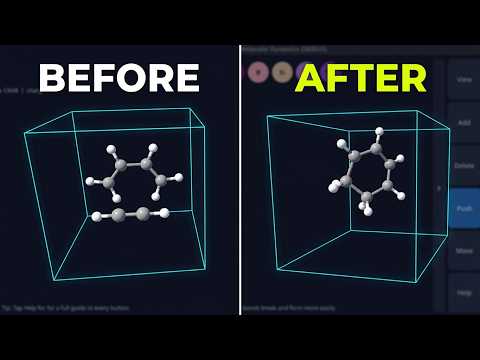
A conjugated diene and a dienophile join in a [4+2] cycloaddition. Two new carbon–carbon sigma bonds form in one concerted step, closing a six-membered ring.
diene + dienophile → cyclohexene ring
Video 3 of 3
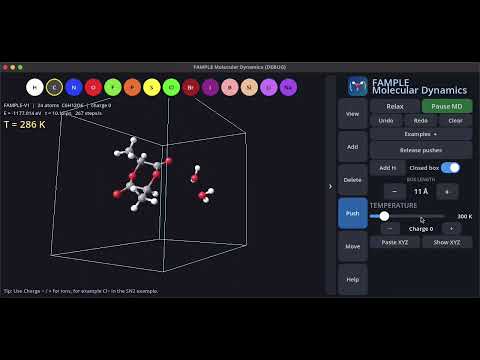
Two lactic acid molecules condense into lactide, a cyclic diester, releasing water. Lactide is the monomer used to make polylactic acid (PLA), a common biodegradable plastic.
2 C₃H₆O₃ → C₆H₈O₄ + 2 H₂O